Visual inspection, also referred to as visual testing, is an essential component of quality assurance in manufacturing companies. Whether in the automotive sector, electronics manufacturing, plastics processing, or food production: wherever products are manufactured, defects must be detected, documented, and prevented.
Traditional visual inspection is often carried out manually by trained personnel. However, the potential for greater efficiency and precision through automation and digitalization is enormous, which is why companies are increasingly relying on automated visual inspections – especially since AI can now be used to automate particularly complex use cases.
Visual inspection (also known as optical inspection or testing) is a non-destructive testing method that involves the visual examination of a product for surface defects, scratches, cracks, or dimensional deviations – using either the naked eye or technical aids such as cameras and sensors. Visual inspection can be used both for early defect detection during the production process and in the final quality control phase. Since it is cost-effective compared to destructive methods and the tested products can still be used, a 100% inspection of every component can be implemented economically.
As the world's most widely used non-destructive testing method, it is a key component of industrial quality assurance and contributes significantly to maintaining the highest quality and safety standards.
Manual visual inspection
Visual inspection has evolved significantly over recent decades. Initially, it was performed entirely manually by trained specialists whose experience and attentiveness were critical to defect detection. However, human limitations such as fatigue, subjective perception, and limited repeatability made this method prone to errors, expensive, and difficult to scale.
Rule-based systems
With the advent of digital technologies, rule-based camera-guided systems were introduced. These classic automated solutions provided more consistent and faster inspections. Based on fixed rules and image processing, they function reliably with clearly defined defect patterns. Their greatest weakness: a lack of flexibility. As soon as product variants, complex surface structures, or irregular defect patterns come into play, these systems reach their limits. They require constant readjustment and manual intervention.
AI-based visual inspection
AI systems represent the latest stage of development. Using deep learning, they mimic human cognitive abilities. They learn what "good" and "bad" parts look like – not through rules, but based on real-world training data. These systems also identify previously unknown defects and can learn highly complex patterns, achieving the inspection accuracy of a consistently attentive human.
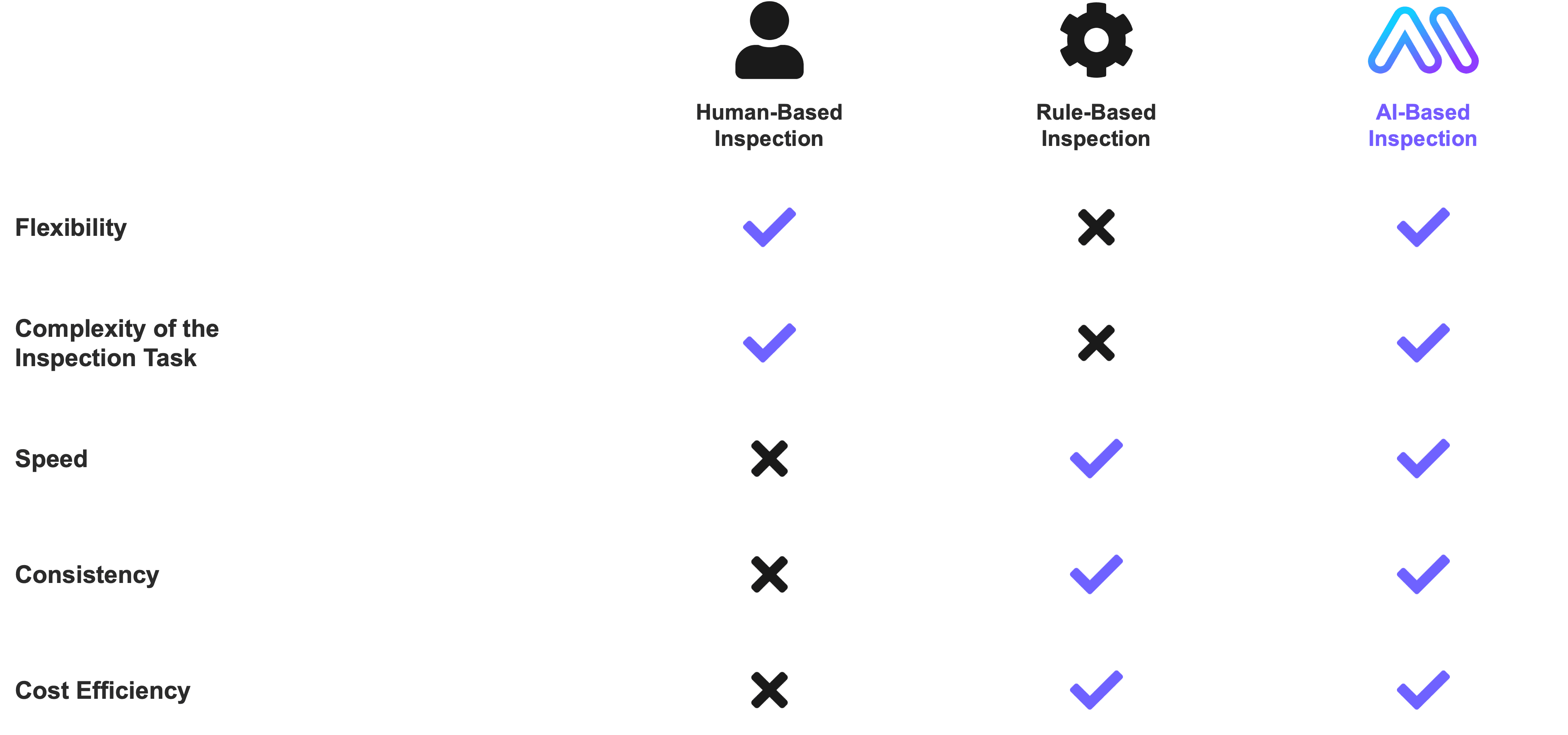
While manual inspection is still widely used, its capabilities are increasingly reaching their limits in modern, fast-paced production environments. Rule-based systems offer more consistency but remain rigid. AI-based inspections combine the strengths of both approaches, enabling flexible, scalable, and intelligent quality control – ideal for automating complex use cases, high-mix manufacturing, and Industry 4.0.
In addition to automation through AI-powered computer vision, modern visual inspection delivers another crucial value: data-driven process optimization.
Instead of merely identifying defects, automated inspection continuously delivers structured information on quality deviations. This data enables a systematic analysis of root causes, uncovers patterns in the production process, and supports targeted improvement measures. In this way, visual quality control evolves from a pure inspection tool into an active lever for efficiency, transparency, and strategic advancement in manufacturing.

What is visual inspection in industrial applications?
Visual inspection is a non-destructive method used to check products for surface defects such as scratches, cracks, or shape deviations. It can be performed manually by trained personnel or automated using camera systems – more and more often supported by artificial intelligence (AI).
What are the advantages of AI-based visual inspection over manual methods?
Is AI-powered visual inspection suitable for small and medium-sized enterprises (SMEs)?
Can AI systems detect unknown or unexpected defects?
What kind of data is generated through automated visual inspection - and how can it be used?
Does AI completely replace human inspectors?
What are the prerequisites for implementing AI-powered visual inspection?