This guide shows how AI is transforming production, introduces the most important use cases with measurable business benefits, and provides practical advice on organization, security, and compliance.
Key takeaways:
What does AI in production mean? AI (primarily deep learning here) refers to the use of data-driven models that learn patterns from data to control quality and processes.
How is AI used in manufacturing? It supports, among other things, visual quality inspection, predictive maintenance, process parameter optimization, production planning/control, and energy and resource management.
What are the benefits? Higher quality (less waste/rework), increased productivity (more stable cycle times, shorter throughput times), greater resilience (fewer downtimes), and lower energy/material consumption.
Why is data quality crucial? Models are only as good as their data. Only with consistent, high-quality data can AI models be developed that are suitable for regular operation.
What is MLOps and why is it important? MLOps is the set of processes and tools for the development, deployment, and operation of ML models, ensuring stable regular operation through versioning, CI/CD, monitoring, and secure rollbacks, among other things.
Artificial Intelligence (AI) is a broad term: it describes the ability of computer systems to perform tasks that typically require human cognitive abilities – such as understanding language, recognizing patterns, or making decisions. AI is not a single technology, but rather an umbrella term for various methods. When we speak of AI in production, we primarily mean data-driven processes, i.e., Machine Learning (ML). There are numerous approaches, learning algorithms, and model types. However, the greatest progress in recent years is due to Deep Learning – which is why, for the sake of simplicity, we equate "AI" with Deep Learning in the remainder of this article. The central difference to classic, rule-based automation: AI learns patterns from data instead of exclusively following fixed, predefined rules.
AI can optimize production processes: It detects patterns in sensor, image, and IT data, reports anomalies early, and suggests target values – always in interaction with expert knowledge that defines goals, limits, and approvals. However, humans remain a crucial component of production. They provide learning signals (e.g., by labeling defects), curate data, validate models, implement measures, and monitor operations as well as compliance.
According to the Fraunhofer Institute, 16% of manufacturing companies in Germany used artificial intelligence in production in 2022. Larger companies with 500 or more employees led the way with an adoption rate of around 30%, while another 13% planned to introduce it. There were also significant differences between industries: in the automotive sector, the rate was around 31%, compared to 8% in the chemical and pharmaceutical industries. A Bitkom survey among industrial companies with at least 100 employees showed that 42% were already using AI in production by 2025, and another 35% planned to do so. In contrast, the Federal Statistical Office reported for 2024 that around 20% of companies across all industries in Germany used AI. In other words, the use of AI in the economy and in the manufacturing sector is increasing significantly, but still varies greatly depending on company size and industry.
It all starts with data. This is generated in abundance during production and comes from a wide variety of sources: signals from programmable logic controllers (PLCs), sensor data from machines, images from cameras and automated optical inspection, measurement series from test benches, and contextual data from MES and ERP systems. Especially when these sources are cleanly integrated, artificial intelligence in production can generate relevant insights to increase production efficiency.
Machine Learning in Manufacturing: An Overview of Learning Methods
Based on this data, different types of AI models can be trained. In practice, supervised learning (Supervised Learning) is the most commonly chosen approach: models are trained using human-labeled examples, for example to classify parts as "good" or "bad" or to predict quality characteristics via regression. Unsupervised learning (Unsupervised Learning) can help uncover hidden patterns and reveal previously unknown relationships, while at the same time identifying unusual anomalies early on through anomaly detection – especially in environments where errors occur very rarely. Reinforcement learning (Reinforcement Learning), i.e., learning through trial and error, is only used in clearly defined sub-processes where safety concerns are minimal. Strict quality and safety boundaries set the limit here.
AI in Manufacturing: Data Quality Makes the Difference
The decisive factor is not just the volume of data, but the quality of the training data. One of the oldest rules in machine learning still applies: "Garbage in, garbage out". This is especially true for supervised learning, as the AI relies on human input to learn. However, humans often make subjective and inconsistent decisions. To prevent such inconsistencies from being transferred into the training data and ultimately into the AI model, professional tools and well-thought-out labeling strategies are essential. AI in manufacturing benefits from targeted measures such as Golden Samples, annotation by subject matter experts, clear guidelines for borderline cases, random spot checks, and methods like active learning or the generation of synthetic data to systematically supplement rare or missing data.
From Training to Deployment: Edge vs. Cloud
Technically, training and inference are often separated. Training usually takes place centrally, often in the cloud or a data center with high computing power. Inference, i.e., the actual execution of the model, often runs at the edge on local industrial PCs directly on the line to ensure low latency and high availability. Crucial requirements for this include robust fallback mechanisms during network outages, distributed updates with rollback capability, and an OT-compliant security architecture with network segmentation, hardened devices, and clearly defined roles.
Explainable AI for Traceable Decisions
To prevent results from becoming a black box, explainable AI (Explainable AI, or XAI) helps make model decisions more transparent. Although this is still an active field of research, models can already often highlight which features were decisive – such as anomalous areas on an image or particularly influential process parameters. In quality control and manufacturing, the AI can therefore provide threshold values, confidence scores, and protocols alongside predictions – precisely the artifacts required by quality assurance teams and factory acceptance testing processes. This makes AI auditable, verifiable, and reliable enough to become a trusted part of daily line operations.
Artificial intelligence in production is no longer a future concept, but a reality in many manufacturing companies. Whether in quality assurance, maintenance, or production planning – AI-based solutions increase efficiency, transparency, and response speed along the entire value chain. The following use cases demonstrate where AI in manufacturing is already delivering concrete added value today.



Artificial intelligence in production unlocks measurable potential – from higher product quality and increased productivity to greater sustainability and delivery reliability. The following areas demonstrate how companies are already achieving real business impact with AI technologies today.
Scaling artificial intelligence in production succeeds when domain experts without deep AI expertise can independently run through the Machine Learning development process – meaning they can train, adapt, and deploy models directly to the line. No-code platforms in particular accelerate this process noticeably. Quality and production specialists contribute their domain knowledge directly – typically in three simple steps: label data, start training, evaluate results. This lowers barriers to entry, shortens time-to-value, and enables many small iterations. This allows AI in manufacturing to be deployed quickly and efficiently without relying on data science teams every single time.
Monitoring AI in Production
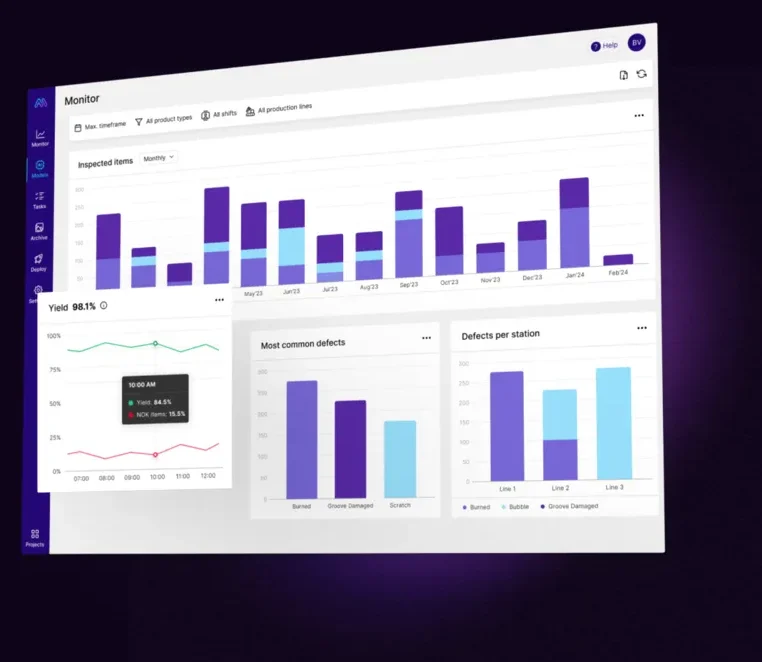
During operation, monitoring is required to track model performance and report drift early on, so that immediate action can be taken if necessary. Good no-code solutions also include versioning and rollbacks, allowing teams to roll back models in a controlled manner if needed, without putting the production line at risk.
These features are essential for running artificial intelligence in production stably and securely over the long term.
Robust Architecture for AI in Manufacturing
Machine Learning in production requires a technical infrastructure that withstands real-world shop floor conditions. This is why many models run directly on edge devices at the line – with minimal latency and independently of cloud connections. An additional cloud component simultaneously enables cross-site learning, centralized governance, and secure updates. This allows model versions to be compared, best practices to be shared between plants, and quality standards to be raised sustainably. For OT/IT managers, connectivity is key: open protocols and APIs to PLCs (programmable logic controllers), MES (Manufacturing Execution System), and ERP (Enterprise Resource Planning) – from digital I/Os and OPC UA to REST – prevent data silos. Only when the solution integrates seamlessly with the existing ecosystem does it deliver its full value: from the shop floor cell to the management dashboard.
Collaboration Across All Corporate Functions
The successful deployment of AI in production highly depends on the interaction between different departments. IT is responsible for the platform, network, and security. OT connects machines and lines. Quality assurance defines inspection criteria, while production operates the solution in day-to-day business.
A good AI software for manufacturing supports this collaboration. It allows domain experts to label examples, define rules, and evaluate models directly within the tool. At the same time, centralized governance features such as role management, approvals, and logging ensure traceability and auditability.
When the software involves all stakeholders, is based on a robust yet flexible architecture, and is supported by sound processes, an AI project can be reliably scaled from a pilot to multiple plants.
The biggest hurdles for AI in manufacturing rarely lie in the technology itself, but rather in a lack of clear objectives and insufficient integration into existing processes and systems. Small and medium-sized enterprises in particular often face major challenges: they frequently lack a solid data foundation, qualified specialists, or sufficient trust in new methods. Skepticism remains high, especially regarding topics like data sovereignty and the validation and certification of AI systems.
Project Management
As with any innovation project, the introduction of AI in production requires business-driven planning before implementation. This means defining the specific use case, establishing measurable goals, and setting up a solid business case. Without clear target metrics, AI easily remains a pilot without impact. However, the buzzword "AI" often leads to rushed efforts to achieve quick wins with inflated expectations and unclear use cases.
Integration into the Existing System Landscape
Legacy machinery and diverse, historically grown system landscapes complicate data access. In addition, heterogeneous machines, proprietary interfaces, and latency and availability requirements make integration into line operations difficult. These factors must be taken into account when planning the time and investment required for an AI project.
From Pilot to Regular Operation
Many companies manage to launch an AI pilot project – but only a few successfully transition artificial intelligence in production into stable regular operations. The relevance of MLOps is often underestimated: continuous monitoring, managing model and process drift, updates with rollback capabilities, and clear responsibilities are essential for using AI in production. Equally important is the collaboration between data experts, production, and quality. Therefore, user acceptance and change management are key: who makes decisions, who intervenes when, and who documents? Without clarity, AI remains in the experimental stage.
Regulatory Requirements
The EU AI Act introduces new rules for the use of artificial intelligence in manufacturing. This is particularly relevant for production if AI influences product safety functions or manages/monitors employees (in which case high-risk obligations apply). Proven "AI-Act-Lite" practices (clear purpose limitation, high data quality, traceability, and early involvement of quality assurance) pay off in any project. Even though personal data is typically rarely processed on the shop floor, data privacy should be on the agenda right from the start.
If companies address these points early on – with a clearly defined use case, measurable goals, and processes and tools that enable safe operation and involve all stakeholders – the chances increase that AI will reliably grow from a pilot to a production standard.
AI and Machine Learning in production deliver value where data and domain knowledge converge: it improves quality (automated optical inspection, higher First Pass Yield), increases productivity (shorter process and setup times, higher Overall Equipment Effectiveness), strengthens resilience and delivery performance (fewer unplanned downtimes, more stable cycle times), and improves sustainability (less waste, lower energy and material consumption). Humans remain key: specialists provide learning signals, validate models, implement measures, and ensure safe, auditable operations.
Successful AI projects in manufacturing require collaboration between IT, OT, quality, and production. The foundation is a clearly defined use case with measurable goals, high data quality, and rigorous MLOps – i.e., the processes and tools that securely transition ML models from development to production and keep them running stably.