Product

Industries

Resources

Company

Surface Inspection, Component Recognition and Data Matrix Code Recognition

Inspection of Printed Circuit Boards

Inspection of Printed Circuit Boards

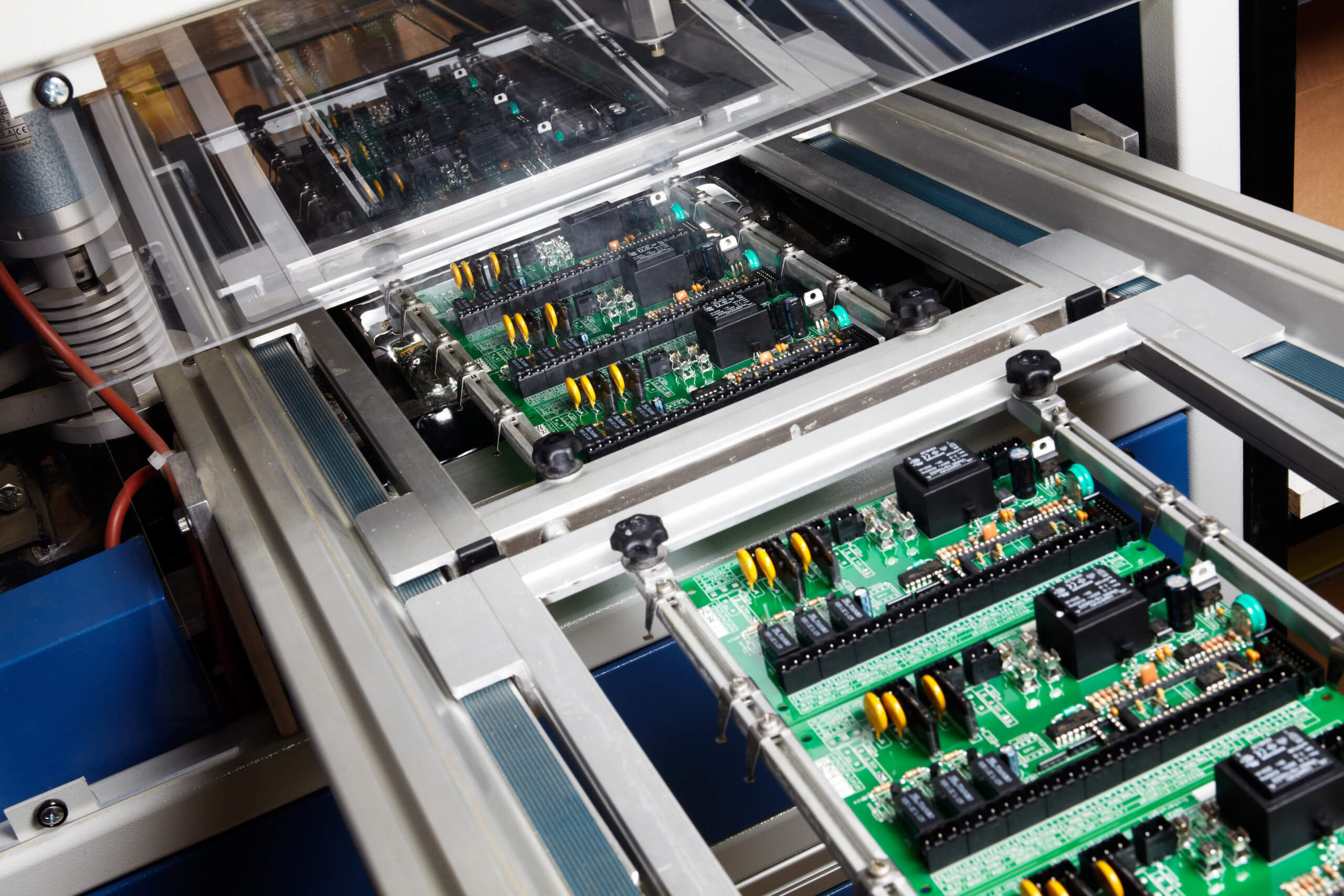
Thanks to Maddox AI’s device and software, incorrectly assembled components and other damages can be detected and tracked to a specific PCB.

Product

Product

Printed Circuit Boards

Industry

Industry

Automotive

Total savings / year​

Total savings / year​

110-160k €

Customer Request

Customer Request

Our customer manufactures printed circuit boards, which were manually inspected by two people in a three-shift operation due to the variety and complexity of the production. A classic inspection system was already used to check individual components – but a hundred percent automated end-of-line inspection did not happen, yet. Maddox AI has developed a semi-automatic inspection system in which printed circuit boards are inspected with a high-resolution camera. Due to the high product variability, a fully automated inspection system was not possible. The system is used to detect, among other things, defectively mounted components and other damages such as scratches, or solder bumps. By reading a data matrix code, the Maddox AI system tracks defects to a specific component. In the first step, the system is loaded manually. New defect classes have already been retrained several times free of charge.

Before

Before

Previous Inspection System

Previous Inspection System

Previous Inspection System

The printed circuit boards were inspected manually in three shifts with a total of six employees. The detection accuracy varied depending on the inspector.

Due to the faulty assembly of printed circuit boards, the production was carried out with an excessively high reject rate.

Since the inspection results were not digitized, no regular structured root cause analysis was performed.

After

After

With Maddox AI

With Maddox AI

With Maddox AI

The printed circuit boards were inspected manually in three shifts with a total of six employees. The detection accuracy varied depending on the inspector.

All products are inspected 100% automatically according to a precise defect definition. The inspection system is operated by one employee per shift.

Since installing Maddox AI, the scrap rate has been reduced by 25%.

Thanks to the digitalized inspection process, process optimizations could be realized (e.g. direct feedback loop for machine setting).

Due to the faulty assembly of printed circuit boards, the production was carried out with an excessively high reject rate.

Since installing Maddox AI, the scrap rate has been reduced by 25%.

Since the inspection results were not digitized, no regular structured root cause analysis was performed.

Thanks to the digitalized inspection process, process optimizations could be realized (e.g. direct feedback loop for machine setting).

0€ Costs

0€ Costs

0€ Costs

For expansion to further product variants

100%

100%

100%

Tracability by reading the data matrix code

40%

40%

40%

Less pseudo scrap

Want to learn more about our solution?

Try it free now!

Would you like to learn more about our solution?

Try it now for free!

Would you like to learn more about our solution?

Try it now for free!

Technician in a cleanroom suit and blue gloves inspecting a microprocessor chip.

With Maddox AI, the inspection of medical microchips is carried out reliably and automatically—defects such as foreign particles, scratches, or overfilling are detected with precision. This ensures consistently high quality and maximum patient safety.

Electronics

Bundles of cables bound together with cable ties, in a close-up.

Retrofit

By upgrading the existing camera system with Maddox AI’s software, the visual quality control of data cables is enhanced with AI-powered defect detection, making it not only more precise but also more consistent.

Electronics

Close-up of an EV battery module's cell contacting system, showing rows of cells connected by busbars and orange wiring.

Maddox AI enables the reliable and automated identification of defects such as sheet metal damage, bubbles in the potting, damaged conductor paths and many more.

Automotive