In this article, you will learn what causes Pseudo scrap, the costs associated with it, and how the False Rejection Rate (FRR) is measured and sustainably reduced. The role of AI in quality control will also be examined in more detail.
Key takeaways:
What is Pseudo scrap? Good parts are incorrectly classified as not OK (n.i.O.) during quality control and sorted out accordingly.
What are the causes? Common causes include insufficient image quality, process changes, and limited inspection logic.
Why is Pseudo scrap a problem for manufacturing? Rejected good parts create no value, even though material, time, and energy have already been invested.
How can the False Rejection Rate be reduced? First, the image quality should be designed in such a way that all relevant features are clearly recognizable. Based on this, inspection algorithms can be developed and optimized using data.
What role does AI play? AI learns from real data and therefore learns to separate good and bad parts better than rule-based systems. In addition, AI can be easily and effectively adjusted to changes in production through targeted data adaptation.
In quality control, a distinction is made between two types of errors: parts that are falsely sorted out as bad, and parts that are falsely let through as good. These are referred to as Pseudo scrap or slippage, respectively.
If products are sorted out by quality control during or after the production process, this is referred to as scrap. However, if parts that meet the quality standards are incorrectly rejected, this is Pseudo scrap (corresponds to the FRR, False Rejection Rate).
We speak of slippage when the opposite occurs: products are let through even though they have defects (corresponds to the FAR, False Acceptance Rate). Both misclassifications cause costs and inefficiencies in production.
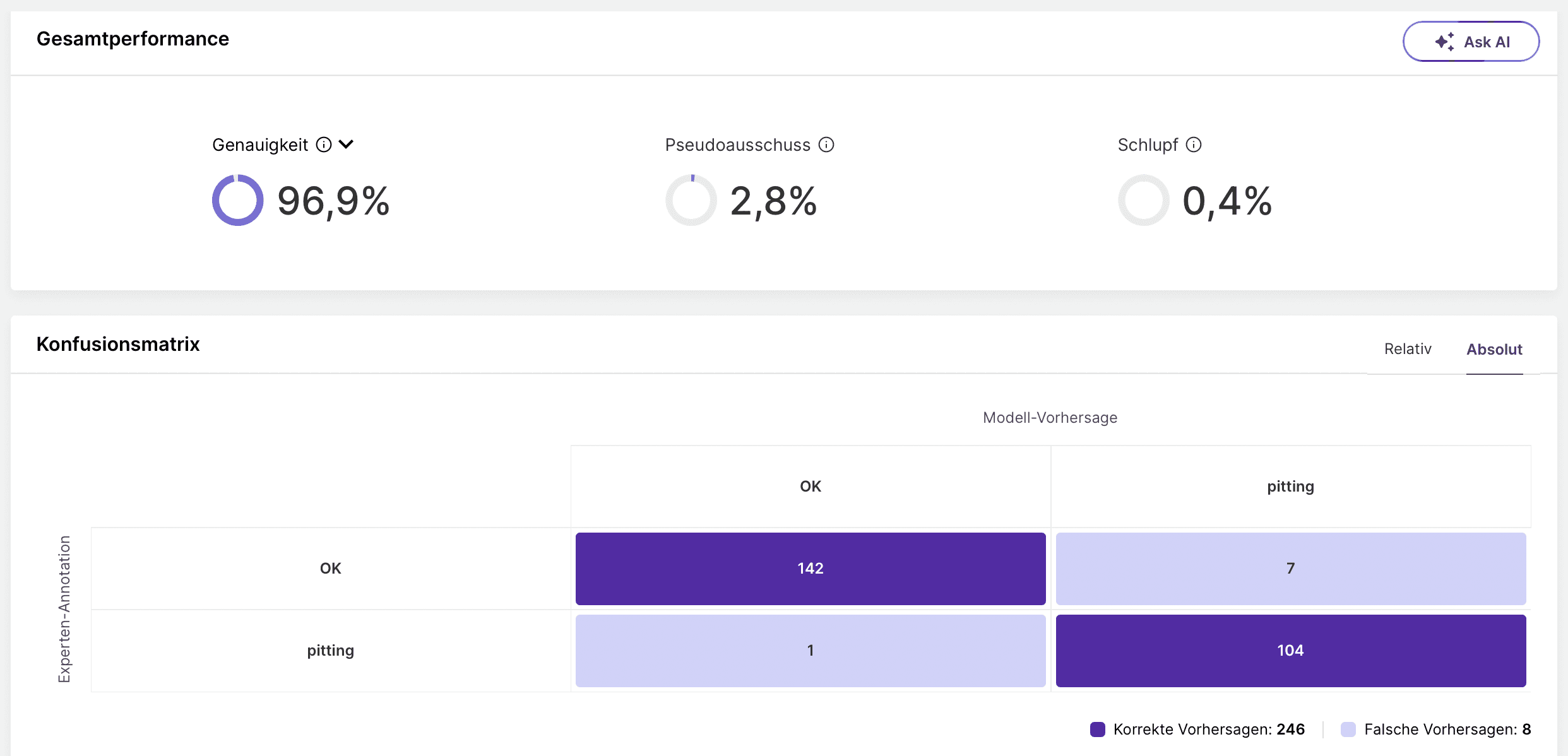
Pseudo scrap burdens the balance sheet through avoidable material, energy, and process costs. Resources have already been invested in manufacturing, personnel, and machine runtime, yet in the end, flawless goods are reworked or even disposed of. This reduces the usable output and ties up capacities that could create value elsewhere.
Financial losses: Every falsely sorted out part represents a direct loss of material, labor time, and margin.
Loss of productivity: Mis-sorting reduces the actual output of the production line because a portion of the defect-free products does not transition into salable inventory.
Inefficient resource utilization: Personnel and equipment used for reworking or disposing of Pseudo scrap are utilized inefficiently.
Falsely sorted out parts have a direct impact on two key production metrics: Yield and OEE. Yield represents the proportion of manufactured parts that actually go to sale as good parts, while OEE (Overall Equipment Effectiveness) describes how effectively equipment is utilized, taking availability, performance, and quality into account.
Falsely sorted out parts have a direct impact on two key production metrics: Yield and OEE. Yield represents the proportion of manufactured parts that actually go to sale as good parts, while OEE (Overall Equipment Effectiveness) describes how effectively equipment is utilized, taking availability, performance, and quality into account.
In quality inspection, two goals collide: not letting defective parts through and not unnecessarily stopping good parts. The stricter the inspection is set up, the fewer real defects slip through – but the number of falsely sorted out good parts (Pseudo scrap) increases. A more tolerant setting allows more good parts to pass, but increases the risk of defective parts going undetected (slippage). The economically optimal point is where the total costs from misclassification, rework, and complaints are minimized.
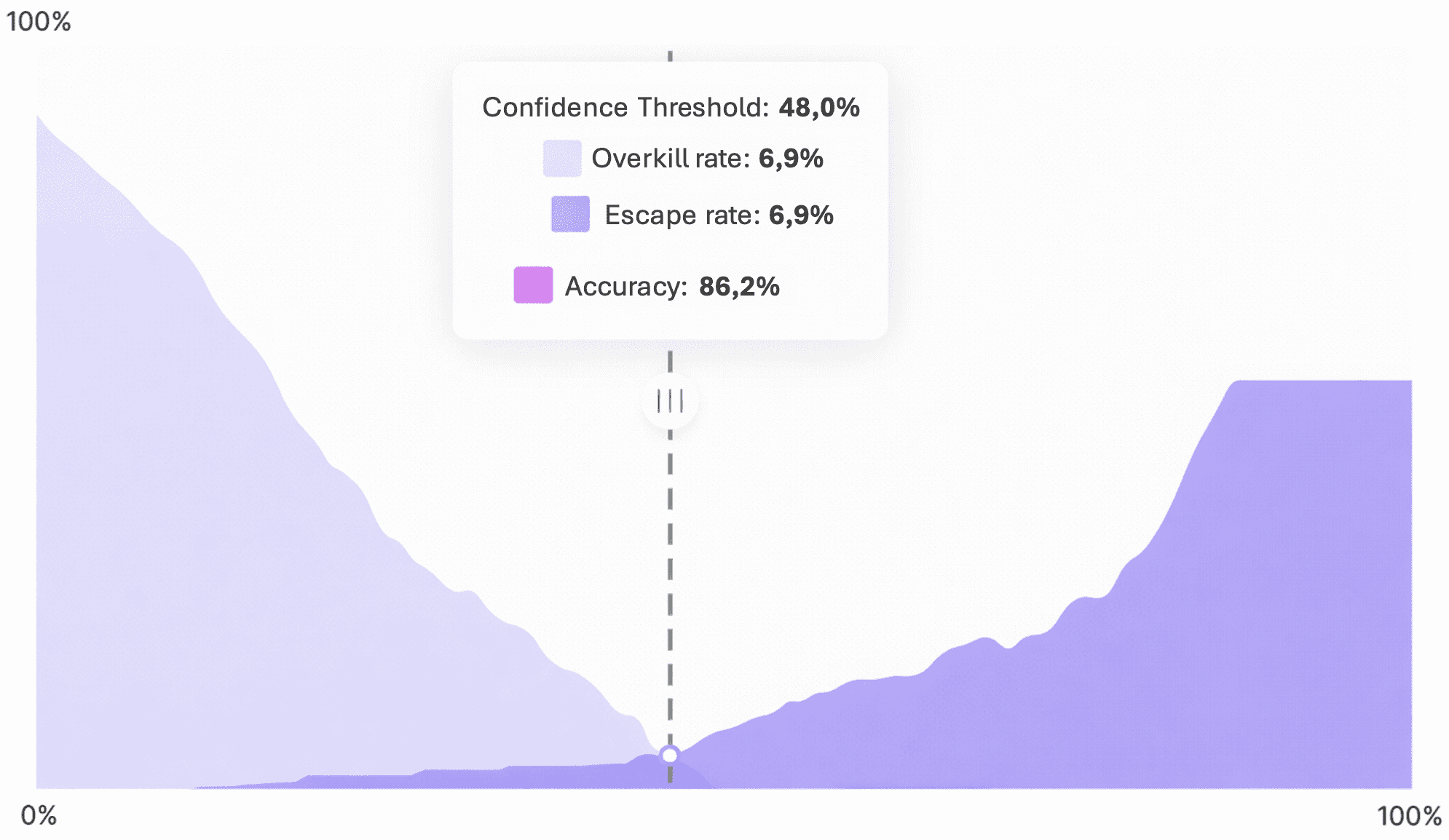
The trade-off between FRR and FAR exists as long as the characteristics of good and bad parts overlap. It can only be resolved if an inspection logic can clearly separate good and bad parts, so that a clear threshold exists without a conflict of goals. This is achieved through data-driven algorithms such as AI, which can map reality's complexity with high accuracy.
A perfectly selective decision between a good and a bad part is rarely possible in practice. Pseudo scrap can have a variety of causes. The following section provides a structured overview of the most important influencing factors:
Companies reduce the False Rejection Rate in visual inspection via three levers: improving image quality, optimizing data and algorithms, and utilizing warning systems to detect deviations at an early stage.
The goal of the inspection setup is consistent and repeatable image acquisition in which features are clearly recognizable. Therefore, the focus is on light and optics. Diffuse, coaxial, or dome lighting can reduce reflections and stabilize contrasts.
Polarization filters and shielding minimize ambient light and secure the repeatability of acquisitions. Constant cycle times, stable trigger and shutter signals reduce variation in the acquisitions. In addition, cleanliness directly affects misclassification. Blowing off or vacuuming contamination before image acquisition can be helpful.
Rule-based programs reach their limits with glare, texture changes, and variants. Constantly changing conditions and complex defect patterns make classification with rigid rules difficult.
Modern industrial image processing therefore relies on AI. It learns robust rules for separating good and bad parts from real data. For this, a consistent Ground Truth with Golden Samples is essential – i.e., referenced sample parts clearly approved as "good" or "bad", which particularly define the boundary area. It determines what the system later recognizes as a good part or a defect.
In addition, AI can easily be adapted to new production conditions: Instead of reprogramming by specialists, the training dataset is simply updated, e.g., by adding the latest production batch.
Even after deployment, regular verification of model performance remains crucial. Continuous monitoring of inspection accuracy makes problems in production visible early on, while notifications in case of rising scrap allow for timely countermeasures.
Pseudo scrap (False Rejection Rate) drives up costs and slows down production efficiency. Because of the diverse causes, a combination of three levers works best: First, the image quality is designed so that all relevant features and defects are reliably visible. Second, a consistent data basis (Ground Truth) is created, ideally with boundary sample parts. Third, the inspection algorithms in production use are continuously monitored via monitoring and adjusted as needed.
AI-supported methods increase selectiveness compared to rule-based systems. In addition, they can be retrained without deep expert knowledge and are well-suited for retrofitting.